


Ask Alec: Before You Throw Away That Worn Leather Chair, Read This First
Before I begin, I want to make one thing perfectly clear.
Everything I’m about to share comes from my own personal experiences working on leather items that I own. These are techniques that have worked well for me on specific types of leather that I knew how to identify before I started.
They are not intended as recommendations for every type of leather.
Leather comes in many different forms, and what works beautifully on one type can permanently damage another. If you’re unsure what type of leather you have, don’t guess. Instead, I would recommend contacting a company that specializes in leather cleaning and restoration before trying any restoration techniques yourself.
Now let me tell you how this all started.
People often ask if it’s possible to restore worn leather instead of replacing it. The answer depends entirely on the type of leather you’re working with.
My Daughter-in-Law’s Purse
A few years ago, my daughter-in-law came to visit. As she walked into our house, she set her black leather purse on the kitchen counter.
It was a beautiful purse, but after several years of use it had definitely begun to show its age. The corners were worn, the color had faded in several places, and overall it simply looked tired.
She looked at it and said, “I really need to replace it.”
I asked her, “Would you mind if I tried something first?”
She smiled and said, “Sure.”
The purse was made from a soft black top-grain leather, similar to what’s commonly used on many quality handbags. Since the wear appeared to be cosmetic rather than structural, I decided to experiment.
I applied a light coat of black liquid shoe polish over the outside of the purse and allowed it to dry. Then I applied a second light coat. After that dried, I buffed the leather with one of those sponge shoe polishers that people often use to restore the shine on black dress shoes.
The entire process took about fifteen minutes.
When I handed the purse back to her, she couldn’t believe the difference.
It looked remarkably close to new.
Then I Thought About My Own Leather Chair
That experience got me thinking.
If it worked that well on her purse, would it work on my own leather chair?
I had a dining chair with a black protected leather seat that had been used almost every day for about fifteen years. The leather itself wasn’t damaged, but the finish had become dull and worn from years of use.
This time I restored only half of the seat before stopping to take a picture.
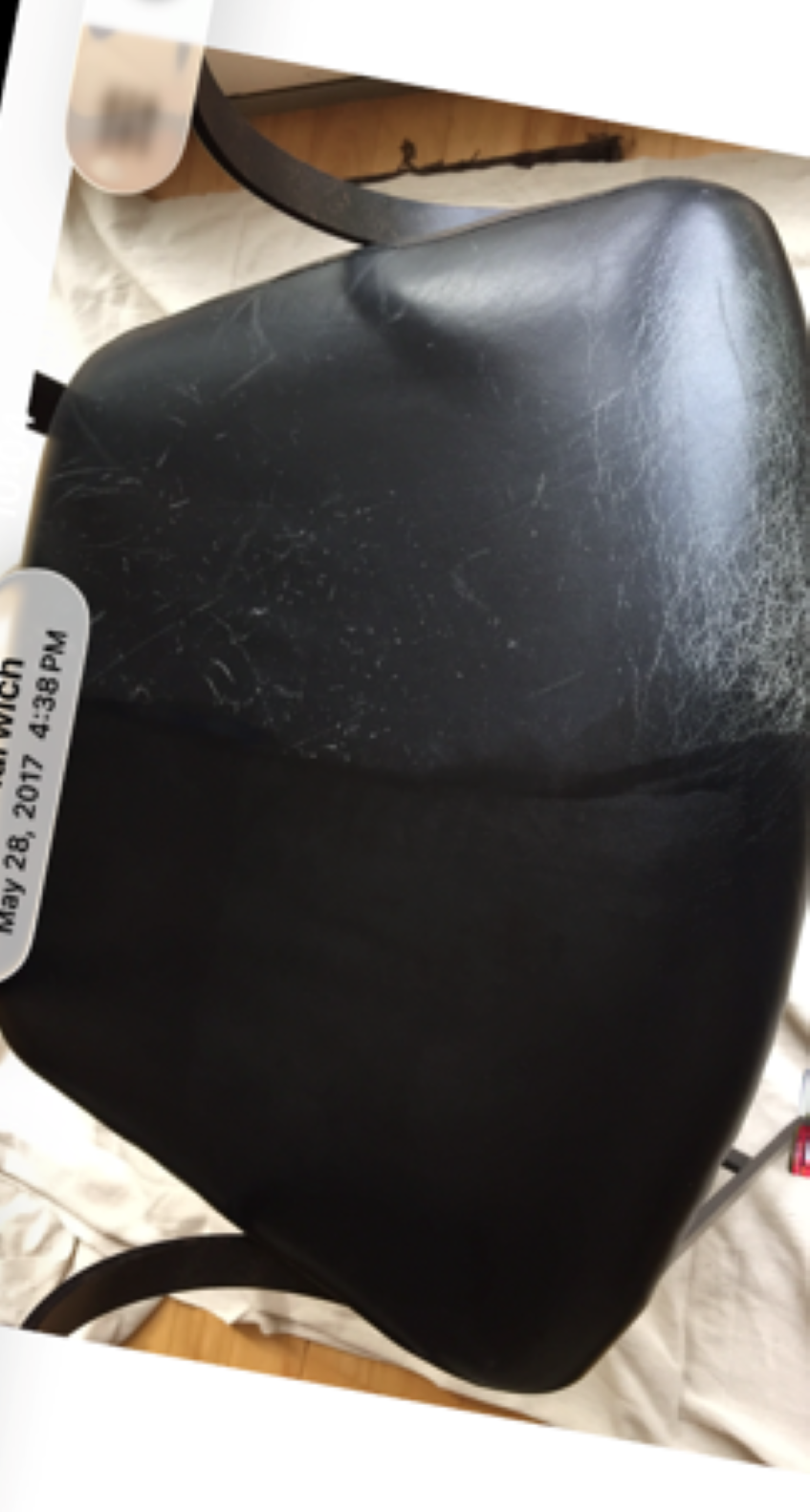
As you can see, the difference between the restored half and the original half was dramatic.
Again, the entire process took only about fifteen minutes and cost less than a dollar in materials.
But Here’s the Important Part
Please don’t read this article and assume that every leather chair can be treated this way.
It can’t.
Leather is not just leather.
There are many different types of leather, and each one has its own characteristics. Understanding the type of leather you’re working with is far more important than knowing what product to use.
Protected (Pigmented) Leather
Many dining chairs, office chairs and family room recliners are upholstered in protected, or pigmented, leather. These leathers have a colored protective finish applied during manufacturing.
As they age, it’s often that protective finish—not the leather itself—that begins to show wear.
The chair shown in my photograph was this type of leather, and on **my own chair** I was very pleased with the results.
Nubuck Leather
Several chairs in my own home are upholstered in nubuck leather.
Nubuck is completely different from protected leather.
It has a very fine nap that gives it a rich, velvety appearance. Over time that nap gradually wears smooth in the areas where people sit or rest their arms. Those areas become shiny and no longer blend with the rest of the chair.
On my own nubuck chairs, I’ve had good success very lightly rubbing those shiny areas with fine 400-grit sandpaper.
Notice I said **very lightly**.
The goal isn’t to sand the leather. It’s simply to raise the nap again so those worn areas blend more naturally with the surrounding leather.
Aniline Leather
I’ve also owned aniline leather furniture.
Certain aniline leathers scratch very easily.
On some pieces, I’ve found that very light surface scratches can sometimes be reduced by gently warming the area with a hair dryer while rubbing it with a clean, soft cloth.
Sometimes that’s all it takes to make a light scratch much less noticeable.
Again, this is simply something that has worked for me on certain aniline leathers that I own.
Cleaning Leather and Restoring Leather Are Two Completely Different Skills
During my career I’ve attended several professional leather cleaning and restoration courses, including training with one of the world’s leading leather restoration experts.
He has restored priceless leather furnishings for museums throughout the world.
Watching someone like that work quickly teaches you something.
True leather restoration is both an art and a science.
Those skills take years—often decades—to develop and simply can’t be mastered in a classroom alone.
I feel comfortable cleaning many types of leather to remove normal surface soil and improve their appearance.
However, stain removal, repairing damaged finishes, correcting color loss, repairing tears and performing true leather restoration require an entirely different level of knowledge and experience.
They’re really two different professions.
Many carpet and upholstery cleaning companies have received training to clean leather.
Far fewer specialize in restoring it.
If your leather has significant staining, cracking, peeling, fading or other damage, I would strongly recommend looking for a company that specializes in **leather restoration**, not simply leather cleaning
While it’s sometimes possible to restore worn leather and greatly improve its appearance, every leather is different. Knowing what type of leather you have is always the first step.
My Final Thoughts
I’ve always believed that quality furniture deserves to be cared for rather than simply replaced.
Sometimes, when you understand the material you’re working with, fifteen minutes of careful work can give an old favorite a whole new life.
Other times, the smartest decision is recognizing when the leather needs the attention of a true restoration specialist.
Knowing the difference is just as important as knowing the technique.
I hope my personal experiences encourage you to take a closer look before throwing away a favorite leather chair or purse.
Just remember…
These are techniques that have worked for me on my own leather furniture because I knew exactly what type of leather I was working with.
If you’re ever in doubt, don’t experiment.
Seek the advice of a qualified leather restoration specialist.
— Alec Houle
About the Author
Alec Houle is the owner of Alec’s Carpet & Upholstery Cleaning LLC. Since establishing the company in 1970, he has specialized in the professional cleaning of fine carpets, upholstery, area rugs and select leather furnishings throughout Eastern Massachusetts and Cape Cod. Throughout his career, Alec has continued his education through advanced cleaning and restoration courses, always believing that understanding the material is the first step toward preserving it.