


Those Cleaning Code Tags May Just Be Wrong
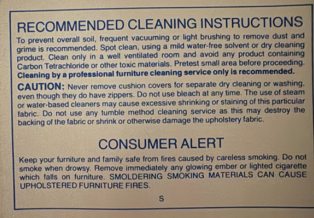
Have you ever removed the seat cushions from your sofa or favorite chair and noticed a white tag attached underneath?
Most homeowners never pay much attention to it. Yet that small tag often raises one of the most common questions I’m asked:
Can I really trust the cleaning code on my upholstery?
Most upholstery manufacturers attach a cleaning instruction tag beneath the seat cushions or underneath the seating platform. These tags are intended primarily as a guide for homeowners when treating an occasional spot or stain. Many also recommend consulting a professional upholstery cleaning service before cleaning the entire piece of furniture.
The four most common cleaning codes are:
• W – Clean using water-based cleaning products.
• S – Clean using solvent-based cleaning products.
• SW – Either water-based or solvent-based cleaning products may be used.
• X – Vacuum only. Do not use water- or solvent-based cleaning products. For overall cleaning, consult a professional upholstery cleaning service.
At first glance, these codes seem simple enough.
But after more than 55 years of professional upholstery cleaning, I’ve learned that those little letters are only one piece of a much larger puzzle.
One Experience Changed My Perspective
Several years ago, I was cleaning upholstered furniture in one of Boston’s premier interior design showrooms. Because customers occasionally left spots or marks on display furniture, I was regularly asked to clean individual pieces to keep everything looking their best.
While working there, I noticed something unusual.
A matching sofa, loveseat, and chair—all made by the same manufacturer and upholstered in the exact same fabric—had different cleaning codes.
I expected every piece to carry the same recommendation.
Instead, one piece was labeled W.
Another was labeled S.
The third carried yet another cleaning code.
I pointed this out to the showroom manager. We both examined the furniture and agreed there was no obvious reason why matching furniture upholstered in the same fabric should have different cleaning codes.
It certainly made me curious.
The Story Didn’t End There
Then I remembered another experience several years earlier.
I had been asked to inspect a sofa that had never been professionally cleaned. Although it carried a “W” cleaning code, I noticed that some of the colors appeared to have migrated into neighboring colors.
Curious to understand why, I contacted the furniture manufacturer.
Their answer made sense.
They explained that they manufactured the furniture, but they didn’t manufacture the fabric. They suggested I contact the fabric mill.
So I did.
The fabric manufacturer explained that while they produced the fabric, they didn’t manufacture the yarns or dye the individual fibers. They suggested I contact the thread manufacturer.
When I finally spoke with the thread manufacturer, they explained that they produced thousands of different yarns in countless colors and shades, but they weren’t responsible for assigning upholstery cleaning codes.
After those conversations, I couldn’t help but smile.
It almost felt as though everyone understood one part of the process, but no one could explain the entire picture.
Those conversations taught me something important.
Upholstery cleaning is far more complex than most people realize, and reducing it to a single letter on a tag doesn’t always tell the complete story.
The cleaning code is helpful, but it should never be the only factor considered before cleaning an upholstered piece of furniture.
Before I clean any upholstered furniture, I identify the fabric, inspect its overall condition, test the dyes for color stability when necessary, evaluate the cushion construction, and look for hidden conditions that could affect the cleaning results. Only after completing that evaluation do I decide on the safest cleaning method.
The Most Misunderstood Cleaning Code: X
Many people assume it means the fabric cannot be cleaned.
Over the years, I’ve professionally cleaned many pieces of upholstery carrying an “X” cleaning code with excellent results.
That doesn’t mean every X-coded fabric can—or should—be cleaned.
It simply means I don’t stop my evaluation after reading one letter.
Instead, I ask myself a simple question:
Why did the manufacturer assign this fabric an X cleaning code?
Sometimes there is an excellent reason.
Sometimes there isn’t.
Careful inspection and testing usually provide the answer. Over the years, I’ve learned that asking “why” has taught me far more than simply following the letter printed on a tag.
Related Articles
If you found this article helpful, you may also enjoy these Ask Alec articles:
- Did My Cleaning Shrink Your Cushions?
- Can You Make a Worn Leather Chair Look Like New Again?
- Does Professional Carpet Cleaning Wear Out Your Carpet?
Professional Upholstery Cleaning
Understanding your furniture’s cleaning code is only part of the equation. Different fabrics, dyes, and construction methods often require different cleaning techniques. Learn more about our Professional Upholstery Cleaning Services and how we’ve safely cleaned fine upholstered furniture throughout Greater Boston, the South Shore, and Cape Cod since 1970.
Alec’s Advice
After more than 55 years of cleaning upholstery, I’ve learned that successful cleaning begins long before the first cleaning solution is ever applied.
It begins with careful observation, asking questions, testing when necessary, and understanding the fabric you’re working with.
The tag beneath your cushion is a helpful guide, but it’s only one piece of the puzzle. Experience is what allows a professional to put all of those pieces together and choose the safest cleaning method for your furniture.
If you have questions about your upholstered furniture or would like to schedule a professional cleaning, we’re always happy to help.
Alec’s Carpet & Upholstery Cleaning LLC